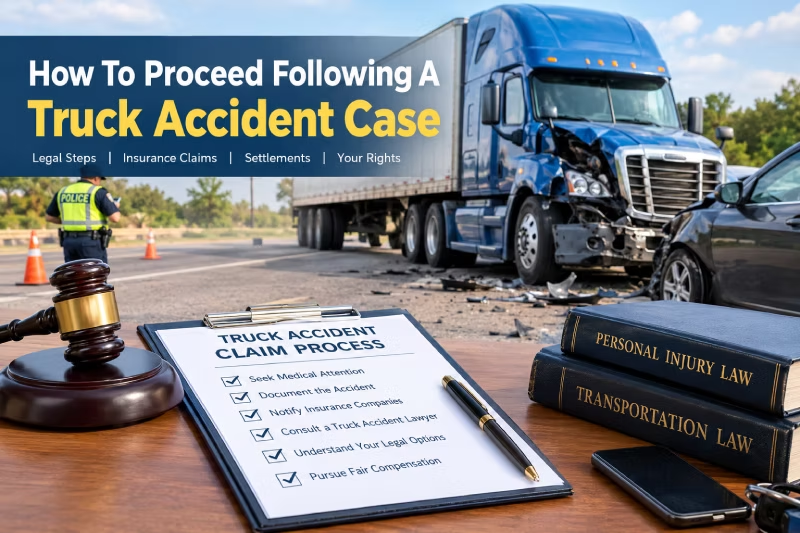
If you are trying to understand how to proceed following a truck accident case, the most important thing to know is that the process does not end when the crash report is completed or the truck is removed from the roadway. A truck accident can involve the driver, trucking company, vehicle owner, maintenance company, cargo loader, insurance carriers, and sometimes other parties.
The case may also involve medical records, electronic logging device data, inspection records, photographs, witness statements, police reports, and state or federal trucking regulations. This guide explains what usually happens after a serious truck crash, how evidence is developed, how an insurance claim moves forward, and when a lawsuit may become necessary.
A truck accident claim is usually more complicated than an ordinary car accident claim because there may be multiple sources of evidence and multiple potentially responsible parties. The legal process also depends heavily on the state where the accident occurred, the facts of the collision, the injuries involved, and the type of trucking operation.
For that reason, there is no single timeline that applies to every case.
What Happens After a Truck Accident?
The first stage is usually focused on safety, medical care, reporting, and evidence preservation. Police or other emergency responders may investigate the scene, injured people may be transported for treatment, and the vehicles may be towed or inspected.
At the same time, important evidence can begin disappearing.
Skid marks can fade. Damaged vehicles can be repaired or sold. Electronic records can become harder to obtain. Surveillance footage may be automatically overwritten. Witnesses can forget details. A trucking company may also have records stored in different systems, which means identifying and preserving the right evidence early can be important.
Federal Motor Carrier Safety Administration data shows why truck crash investigations deserve careful attention. FMCSA maintains the Large Truck and Bus Crash Facts database, which includes information about fatal, injury, and property-damage-only crashes involving large trucks and buses. The agency's data is compiled from sources including NHTSA's Fatality Analysis Reporting System and the Crash Report Sampling System.
In other words, a truck collision should not be treated as only a question of who received a traffic ticket. The investigation may need to examine what happened before impact, why it happened, and whether a trucking-related safety failure contributed to the crash.
Start With Medical Treatment
If you were injured, medical care should come before the legal claim.
Even when pain appears manageable immediately after a collision, some injuries may become more noticeable hours or days later. Examples include back injuries, soft-tissue injuries, traumatic brain injuries, fractures, internal injuries, and psychological effects following a serious crash.
Keep copies of:
- Emergency room records
- Hospital records
- Diagnostic imaging
- Prescription information
- Follow-up appointments
- Physical therapy records
- Specialist evaluations
- Medical bills
- Work restrictions
- Disability documentation
A consistent medical record can help explain the nature of the injury and the treatment that followed.
For example, imagine a passenger suffers neck and shoulder pain after a tractor-trailer collision but initially assumes the symptoms will disappear. Several days later, the person receives imaging and is referred for specialist treatment. The medical timeline can become important because it helps connect the symptoms, diagnosis, treatment, and accident.
Do not exaggerate symptoms, but do not minimize them either. Tell medical professionals what you are actually experiencing.
Identify Everyone Who May Be Involved
One of the biggest mistakes in a truck accident investigation is assuming the truck driver is automatically the only party that matters.
Depending on the facts, a claim may involve:
- The truck driver
- The motor carrier
- The truck owner
- A leasing company
- A trailer owner
- A maintenance contractor
- A parts manufacturer
- A cargo shipper
- A cargo loading company
- A broker or logistics company
- Another negligent driver
- A government entity responsible for roadway conditions
Not every party will be legally responsible in every case. The point is that the investigation should identify the actual relationships between the people and businesses involved.
For example, a driver may operate a tractor owned by one business while working for another company and pulling a trailer owned by a third party. If a mechanical failure contributed to the collision, maintenance records may become important. If cargo shifted because it was improperly loaded, cargo-related evidence may matter.
This is one reason truck accident cases often require more investigation than a simple two-vehicle collision.
Preserve Evidence Before It Disappears
Evidence preservation is one of the most important early steps.
A lawyer investigating a truck accident may seek evidence such as:
- Police and crash reports
- Photographs and videos
- Dash-camera footage
- Traffic-camera footage
- Electronic logging device records
- Driver duty-status records
- GPS information
- Dispatch records
- Driver qualification records
- Vehicle inspection records
- Maintenance and repair records
- Post-crash inspection information
- Cargo and loading records
- Bills of lading
- Cellphone-related evidence when legally obtainable
- Witness information
- Employment records
- Drug and alcohol testing records when applicable
- Insurance information
Federal regulations can make some of these records particularly important.
For example, federal rules generally require covered motor carriers to use electronic logging devices to record drivers' duty status, subject to specific exceptions. The regulations also prohibit false duty-status reporting and tampering with ELD systems.
The federal rules also require motor carriers to maintain certain accident-register information for three years after an accident. The accident register includes information such as the date and location of the accident, driver name, injuries, fatalities, and certain hazardous-material information, along with copies of required accident reports.
Maintenance evidence can be equally important.
Under federal regulation, motor carriers must systematically inspect, repair, and maintain vehicles under their control. Required maintenance records include information about inspections, repairs, and maintenance, and certain records must be retained for specified periods.
That means a serious truck accident investigation may ask questions such as:
Was the truck properly maintained?
Were known mechanical problems repaired?
Was the driver operating within applicable hours-of-service requirements?
Was the cargo properly secured?
Was the driver properly qualified and trained?
Did the trucking company follow applicable safety requirements?
The answers must come from evidence rather than assumptions.
Understand the Role of Federal Trucking Regulations
Federal Motor Carrier Safety Regulations can become an important part of a truck accident investigation, particularly when the trucking operation falls under federal rules.
The regulations cover many areas, including:
- Driver qualifications
- Hours of service
- Electronic logging devices
- Vehicle inspection
- Maintenance
- Cargo-related requirements
- Drug and alcohol testing
- Safety records
- Accident reporting and recordkeeping
For example, federal regulations require motor carriers to investigate certain aspects of a driver's previous safety performance history when hiring drivers. The regulation includes information concerning prior accidents and other safety-performance information.
However, a federal regulation violation does not automatically answer every question about civil liability.
A personal injury case generally requires an analysis of the applicable state law, the evidence, causation, damages, and the specific facts of the collision. A lawyer may use regulatory evidence as part of the broader case, but the legal effect of a particular violation can differ depending on the jurisdiction and circumstances.
This distinction is important.
Regulations Are Evidence, Not the Entire Case
Consider a hypothetical situation where a driver appears to have exceeded applicable driving limits before a crash.
That fact could be relevant. But investigators may still need to establish whether the driver's condition or excessive driving time actually contributed to the collision, whether another factor caused the crash, and what law applies to the claim.
Likewise, finding a maintenance issue does not automatically prove that the maintenance problem caused the accident.
A strong truck accident case connects the evidence in a logical chain:
Safety issue → actual condition → crash mechanism → injury → financial loss.
That is much more useful than simply collecting a long list of alleged violations.
Report the Accident and Obtain the Available Records
The police report can be an important starting point, but it should not necessarily be treated as the final word on liability.
A crash report may contain:
- Driver information
- Vehicle information
- Insurance information
- Statements
- Roadway observations
- Weather conditions
- Diagrams
- Citations
- Officer observations
- Preliminary conclusions
The report may also identify witnesses or other evidence that can be investigated further.
For truck drivers and trucking companies, documentation obligations can extend beyond the police report. Federal regulations require carriers to make accident-related records available to authorized investigators when properly requested, and carriers must maintain an accident register containing specified information.
For an injured person, obtaining the report and preserving other available evidence can help establish a reliable timeline.
Notify the Insurance Companies Carefully
After a truck accident, insurance companies may contact the people involved relatively quickly.
That is normal.
The problem can arise when an injured person gives a detailed recorded statement, signs documents, discusses settlement, or makes assumptions about fault before understanding the full extent of the case.
A basic notification of an accident is different from providing a detailed statement about disputed liability or long-term medical consequences.
If an insurance representative asks questions, consider:
- Who is the insurer?
- Whom do they represent?
- What information are they requesting?
- Is the conversation being recorded?
- Have all injuries been diagnosed?
- Has the full scope of damages been established?
- Has legal counsel been retained?
Do not knowingly provide false information. At the same time, avoid guessing when you do not know an answer.
A simple statement such as “I do not know” is generally better than guessing about speed, distance, timing, or another technical fact.
Be Careful With Early Settlement Offers
An early settlement offer may look attractive when medical bills are arriving and income has been lost.
But settlement decisions should be made only after understanding what the settlement is intended to resolve.
Truck accident injuries can involve future medical treatment, lost earning capacity, rehabilitation, permanent limitations, and other losses. If someone accepts a settlement and signs a release, the ability to seek additional compensation may be limited or eliminated, depending on the agreement and applicable law.
For example, suppose someone receives a quick offer shortly after a collision involving a commercial truck. At that point, the person may know the emergency-room bill but not yet know whether surgery, physical therapy, or long-term treatment will be necessary.
That difference can be significant.
A settlement should be evaluated against the full known and reasonably expected damages, not simply today's bills.
The exact damages that may be recoverable vary by state and case.
When Should You Speak With a Truck Accident Lawyer?
There is no universal rule requiring every truck accident victim to hire an attorney.
However, legal advice can be especially useful when the collision involves:
- Serious or permanent injuries
- A fatality
- Multiple vehicles
- A commercial trucking company
- Disputed fault
- Significant lost income
- Large medical expenses
- Possible regulatory violations
- A mechanical failure
- Multiple insurance policies
- A potential wrongful-death claim
- A dispute over the cause of the collision
Truck accident litigation can involve significant evidence that an individual may have difficulty obtaining independently.
A lawyer may begin by identifying the parties, determining which law applies, evaluating available insurance coverage, preserving evidence, reviewing medical records, investigating the crash, and determining whether a formal claim or lawsuit is appropriate.
That does not mean every case must go to court.
Many personal injury claims are resolved through negotiations. Others require litigation because the parties cannot agree about liability or the value of the claim.
The important point is to understand the evidence before deciding how the case should proceed.
A Simple Early-Stage Truck Accident Checklist
If you or a family member has been involved in a serious truck collision, organize the case around these initial steps:
- Get appropriate medical treatment.
- Obtain the police or crash report.
- Photograph vehicles and visible injuries when possible.
- Preserve videos and photographs.
- Write down what you remember while the details are fresh.
- Collect medical bills and treatment records.
- Keep documentation of missed work.
- Identify witnesses.
- Keep insurance correspondence.
- Do not delete messages, photographs, or relevant documents.
- Avoid posting detailed statements about the accident on social media.
- Identify the trucking company and other involved businesses.
- Ask about preservation of important truck and driver records.
- Be cautious before giving recorded statements.
- Do not rush into a settlement before understanding the damages.
- Check the applicable deadline for filing a legal claim.
The last point is especially important because deadlines are controlled by applicable law and can vary substantially between states and between types of claims. Claims involving government entities, wrongful death, minors, workers' compensation, or other special circumstances may involve different rules.
The Goal of the Next Stage
Once the immediate evidence has been preserved and the parties are identified, the case moves into a more detailed investigation.
That stage is where the difference between a basic accident report and a developed truck accident case becomes clearer.
Investigators may reconstruct the collision, examine vehicle damage, review photographs, compare witness accounts, analyze driver records, inspect maintenance history, study roadway conditions, evaluate medical evidence, and determine how the crash caused the claimed injuries.
The investigation should answer several basic questions:
- What happened?
- Who or what caused it?
- What evidence supports that conclusion?
- Who may have legal responsibility?
- What injuries and losses resulted?
- What insurance or other sources of compensation may apply?
- What deadline controls the claim?
These questions provide the foundation for the next phase of the case.
That same principle is useful for readers, too: the most valuable legal information is information that answers the practical questions people actually face after a crash.
The next stage is therefore not simply about filing paperwork. It is about building a clear factual record, identifying the legal issues, calculating the losses, and determining whether the claim can be resolved through negotiation or must proceed toward litigation.
Authoritative references for the article
Investigating Liability in a Truck Accident
After the initial evidence has been preserved, the next major task is determining who may be legally responsible for the collision.
Liability is rarely established by one document. Instead, the case may be built from several pieces of evidence that fit together.
For example, suppose a tractor-trailer crosses into another lane and hits a passenger vehicle. The investigation may examine whether the driver was distracted, fatigued, speeding, improperly trained, under the influence of alcohol or drugs, unfamiliar with the route, or responding to pressure from a carrier to meet a delivery schedule.
It may also examine whether a mechanical problem contributed to the loss of control.
The goal is not simply to find something wrong. The goal is to determine whether a particular act or failure caused or contributed to the crash and the resulting injuries.
Driver Conduct and Hours of Service
Driver fatigue can become an important issue in some truck accident cases.
Federal hours-of-service rules generally limit property-carrying commercial drivers to 11 hours of driving within a 14-hour period after at least 10 consecutive hours off duty. There is also a 30-minute break requirement after eight cumulative hours of driving, along with weekly limits and specific exceptions.
These rules matter because investigators may compare the driver's actual activities with the driver's recorded duty status.
An investigation might examine:
- Electronic logging device records
- Fuel purchases
- Toll records
- GPS information
- Dispatch instructions
- Delivery appointments
- Weigh-station records
- Bills of lading
- Rest-period information
- Driver communications
- Prior and subsequent trip information
Imagine that a driver reports beginning a trip at 7:00 a.m., but electronic records, fuel receipts, and dispatch information suggest the driver had already been working for several hours.
That discrepancy would not automatically establish liability. It would, however, create a factual issue that may deserve further investigation.
FMCSA explains that hours-of-service rules are intended to regulate the amount of time commercial drivers may remain on duty and drive, including required rest periods.
Investigating the Trucking Company
The trucking company may have responsibilities that extend beyond simply hiring a driver.
Depending on the facts, an investigation may examine whether the company:
- Properly screened the driver
- Verified the driver's qualifications
- Maintained required records
- Provided appropriate training
- Monitored safety performance
- Maintained the truck
- Responded to known mechanical problems
- Properly scheduled deliveries
- Properly supervised the driver
- Complied with applicable federal and state requirements
Federal regulations include requirements concerning driver qualification investigations. For example, 49 CFR § 391.23 addresses inquiries into a driver's previous employment and safety performance history. The regulation includes information concerning accidents and other safety-related matters.
That does not mean that every accident involving a commercial driver creates liability for the employer. The facts, applicable state law, employment relationship, and causal connection must still be examined.
Examining the Truck and Its Mechanical Condition
A truck can weigh many times more than a passenger vehicle, and its braking, steering, tires, suspension, lighting, and other systems can affect how it responds during an emergency.
Federal regulations require motor carriers to systematically inspect, repair, and maintain vehicles under their control.
That makes maintenance evidence potentially important.
A truck accident investigation may therefore examine:
- Brake condition
- Tire condition
- Steering components
- Suspension components
- Lights and signals
- Coupling systems
- Trailer condition
- Previous repair orders
- Inspection reports
- Maintenance schedules
- Defect reports
- Parts replacements
- Post-crash inspection findings
For example, if a truck loses braking ability before striking another vehicle, investigators may need to determine whether the failure occurred suddenly or whether there were signs of a pre-existing problem.
A worn component does not automatically prove negligence. An expert may need to determine whether the component was defective, improperly maintained, unexpectedly failed, or played a role in the collision.
Cargo Loading Can Also Matter
Cargo can be another important part of the investigation.
Federal regulations require cargo to be properly secured under applicable requirements. The condition and loading of cargo may therefore become relevant when a trailer overturns, cargo shifts, or a load falls onto the roadway.
A case may involve questions such as:
- Who loaded the cargo?
- Who secured it?
- What type of cargo was being transported?
- Was the cargo within applicable weight limits?
- Was the load distributed properly?
- Were tie-downs or other securement devices used?
- Were there signs that the load shifted before the crash?
- Did improper loading affect vehicle stability?
Consider a tractor-trailer carrying heavy equipment. If the load shifts during a sharp maneuver, the truck may behave differently from what the driver expects.
The investigation must determine whether the loading condition actually contributed to the collision and whether another party may have been responsible for it.
Building the Causation Case
One of the most important parts of a truck accident claim is causation.
A person may have suffered a real injury, and a trucking company may have committed a regulatory violation, but those facts alone do not necessarily establish that the violation caused the injury.
The case generally needs to connect the relevant events.
A useful way to understand this is:
Conduct → collision → injury → damages.
For example:
A driver becomes distracted → the truck drifts into another lane → the truck strikes a passenger vehicle → the occupant suffers a spinal injury → the injury requires treatment and causes lost income.
Every major link may need supporting evidence.
This is why photographs, vehicle inspections, medical records, witness statements, accident reconstruction, and employment documentation can become important.
Understanding Comparative Fault
Truck accident cases can become complicated when more than one person or company may have contributed to the accident.
Depending on the state's law, the injured person may face allegations of comparative or contributory fault.
Suppose a tractor-trailer changes lanes and strikes a passenger vehicle, but the trucking company argues that the passenger vehicle was speeding.
The case may then involve competing factual questions:
- How fast was each vehicle traveling?
- Who had the right of way?
- Was a turn signal used?
- How long did the lane change take?
- Could either driver have avoided the crash?
- Did roadway conditions affect visibility?
- Was another vehicle involved?
The applicable rules vary by state, so an attorney must analyze the law governing the particular claim.
A percentage of fault can also affect the amount of compensation available in jurisdictions that use comparative-fault systems.
For that reason, do not assume that an insurance company's fault percentage is the legally correct percentage.
It is an assertion that should be tested against the evidence and applicable law.
Calculating the Value of a Truck Accident Claim
Determining damages is another major stage of the case.
A truck accident claim can involve both economic and non-economic damages, depending on the applicable law.
Economic losses may include:
- Emergency medical expenses
- Hospital treatment
- Surgery
- Medication
- Rehabilitation
- Physical therapy
- Future medical care
- Lost wages
- Reduced earning capacity
- Property damage
- Transportation expenses
- Other documented financial losses
Non-economic damages may include legally recognized losses such as:
- Pain and suffering
- Emotional distress
- Loss of enjoyment of life
- Disfigurement
- Loss of consortium
The availability and calculation of these damages depend on state law and the facts of the case.
Current Medical Expenses Are Only One Part
One of the most common mistakes in evaluating an injury claim is focusing only on bills that have already arrived.
Suppose a 42-year-old construction worker suffers a serious back injury in a truck collision.
At the time of an early insurance offer, the worker may have:
- $25,000 in existing medical bills
- Three months of lost income
- Ongoing physical therapy
- A recommendation for additional treatment
The financial impact could continue for years.
If the injury reduces the person's ability to perform physically demanding work, future earning capacity may become a significant issue.
The case therefore may require evidence from doctors, vocational experts, economists, employers, or other professionals.
Using Medical Evidence Correctly
Medical evidence should explain more than the diagnosis.
A strong medical record can help establish:
- What injury occurred.
- When symptoms began.
- What treatment was required.
- How the injury affected daily activities.
- Whether additional treatment may be needed.
- Whether limitations are temporary or permanent.
- Whether the accident caused or aggravated the condition.
Medical causation can become contested, particularly when a person had a pre-existing condition.
A pre-existing condition does not necessarily prevent recovery. But the legal analysis can depend on the facts and the law of the applicable jurisdiction.
For example, if someone had occasional back pain before a crash but became unable to work after a truck collision, medical experts may need to distinguish the person's condition before the crash from the condition afterward.
That distinction can materially affect the damages analysis.
Lost Income and Loss of Earning Capacity
Lost wages are often easier to document than future earning capacity.
Current wage loss may be supported by:
- Pay stubs
- Tax records
- Employer statements
- Employment records
- Leave documentation
- Disability records
Future earning loss can require more detailed analysis.
Suppose an injured driver earns $80,000 per year but can no longer perform the essential physical duties of the job.
The question may not simply be, "How much money was lost this year?"
The broader issue could be whether the person can return to the same occupation, perform different work, work fewer hours, or earn a different wage in the future.
An economic or vocational analysis may be used where appropriate.
Organizing the Evidence for the Claim
A well-organized claim should make it easy to understand what happened and why the requested compensation is supported.
A useful case file may contain sections for:
| Evidence Category | Examples |
|---|---|
| Accident evidence | Crash report, photographs, videos |
| Truck evidence | Inspection, maintenance, ELD data |
| Driver evidence | Qualification, training, duty records |
| Medical evidence | Records, bills, imaging, treatment |
| Income evidence | Pay records, tax documents, employer records |
| Witness evidence | Statements and contact information |
| Property damage | Repair estimates and invoices |
| Insurance | Policies, correspondence, claim numbers |
| Expert evidence | Accident reconstruction, medical, economic |
| Legal evidence | Regulations, statutes, pleadings and orders |
The purpose is not to create paperwork for its own sake.
The purpose is to create a clear factual story supported by evidence.
What Happens When the Insurance Claim Is Submitted?
Once the evidence and damages have been developed, a demand may be presented to the responsible insurance carrier or other party.
A demand package can contain:
- A summary of the collision
- Liability evidence
- Medical records
- Medical bills
- Lost-income evidence
- Property-damage documentation
- Expert opinions when appropriate
- A description of ongoing limitations
- A settlement demand
The exact format varies by attorney, insurer, case, and jurisdiction.
A demand is not the same thing as a lawsuit.
It is generally an attempt to resolve the dispute without formal litigation.
The insurance company may:
- Accept the demand
- Reject the demand
- Make a counteroffer
- Ask for additional documentation
- Dispute liability
- Dispute medical causation
- Dispute the amount of damages
- Claim comparative fault
- Request additional information
Negotiations can take several rounds.
Why the First Insurance Offer May Not Resolve the Case
Insurance companies evaluate claims based on the information available to them.
An early offer may be based on incomplete medical information or a different interpretation of liability.
For example, an insurer may argue that:
The injured person received treatment but recovered quickly.
The claimant's medical records may later show that treatment continued for months and that a specialist diagnosed a lasting impairment.
This is why a settlement evaluation should be based on the developed evidence, not simply the first number offered.
The opposite can also be true. Sometimes further investigation reveals evidence that weakens a claim.
A careful legal evaluation should account for favorable and unfavorable evidence.
What If the Insurance Company Denies the Claim?
A denied claim does not necessarily mean the case is over.
The reason for the denial matters.
Common disputes can involve:
- Fault
- Policy coverage
- Causation
- Medical treatment
- Pre-existing conditions
- Comparative fault
- Damage calculations
- Policy limits
- Whether the defendant is legally responsible
The response should address the actual reason for the denial.
For example, if the insurer disputes liability, the next step may involve additional accident reconstruction or witness evidence.
If the insurer accepts liability but disputes damages, medical and economic evidence may become more important.
The case should therefore be approached as a specific factual dispute, rather than simply a disagreement over money.
When Negotiation Does Not Resolve the Claim
If the parties cannot reach a fair resolution, filing a lawsuit may become necessary.
A lawsuit formally moves the dispute into the court system.
The basic stages can include:
- Filing the complaint.
- Serving the defendants.
- Receiving answers or other responses.
- Discovery.
- Depositions.
- Expert disclosures.
- Motions.
- Settlement negotiations.
- Pretrial proceedings.
- Trial, if necessary.
The exact procedure depends on whether the case is filed in state or federal court and on the rules of the applicable jurisdiction.
A lawsuit does not necessarily mean the case will end at trial.
Many civil cases settle during litigation.
The Complaint Begins the Formal Lawsuit
The complaint generally identifies the parties, states the legal claims being asserted, describes the relevant facts, and identifies the relief being requested.
In a truck accident case, claims may involve issues such as:
- Negligence
- Negligent hiring
- Negligent retention
- Negligent supervision
- Negligent maintenance
- Product liability
- Wrongful death
- Other state-law claims
Not every case supports every claim.
For example, an employer-related claim depends on facts concerning the driver's relationship with the company and the applicable state law.
Likewise, a product-liability claim may require evidence that a defective component contributed to the crash.
The complaint therefore needs to reflect the actual facts rather than simply listing every possible theory.
Discovery: Getting the Evidence From the Other Side
Discovery is one of the most important parts of truck accident litigation.
Under Federal Rule of Civil Procedure 26, parties in covered federal civil cases have disclosure and discovery obligations concerning information and evidence relevant to their claims and defenses, subject to the rule's requirements and limitations.
Discovery can include:
- Interrogatories
- Requests for production
- Requests for admission
- Depositions
- Subpoenas
- Expert discovery
In a truck accident case, document requests may seek records concerning:
- Driver qualification
- Training
- Hours of service
- ELD information
- Maintenance
- Inspections
- Repairs
- Cargo
- Dispatch
- Communications
- Accident investigation
- Safety history
- Company policies
- Insurance coverage
The exact requests depend on the claims and defenses.
Discovery can also expose evidence that changes the direction of a case.
For example, an initial theory might focus on driver distraction. Later discovery could reveal a mechanical problem that changes the focus of the investigation.
That is why litigation should remain evidence-driven.
Depositions in Truck Accident Cases
A deposition is a formal questioning session in which a witness gives testimony under oath, usually outside the courtroom.
Potential witnesses may include:
- The truck driver
- A trucking-company representative
- Eyewitnesses
- Medical professionals
- Accident reconstruction experts
- Maintenance personnel
- Cargo-loading personnel
- Employers
- Other expert witnesses
The purpose is to obtain testimony, identify facts, preserve evidence, and understand what the witness may say later.
A deposition is not simply a conversation.
Answers can become part of the litigation record and may be used in accordance with applicable procedural and evidentiary rules.
For that reason, witnesses should answer truthfully, listen carefully, and avoid guessing.
Expert Witnesses and Accident Reconstruction
Serious truck accident cases sometimes require expert testimony.
An accident reconstruction expert may analyze:
- Vehicle speeds
- Impact points
- Vehicle positions
- Skid marks
- Crush damage
- Event data
- Roadway conditions
- Visibility
- Driver reaction
- Avoidance opportunities
A mechanical expert may examine the vehicle and its components.
A medical expert may address causation, treatment, prognosis, or impairment.
A vocational expert may evaluate work restrictions and employability.
An economist may calculate certain future financial losses.
Not every case requires every expert.
Experts should be used when their specialized knowledge helps answer a disputed issue that ordinary evidence cannot adequately explain.
A Practical Example of How a Case Develops
Consider a hypothetical collision involving a fully loaded tractor-trailer and a passenger vehicle.
The initial police report says the truck struck the passenger vehicle after changing lanes.
At first, the insurance company argues that the passenger vehicle moved into the truck's path.
The investigation then uncovers:
- Dash-camera footage from another vehicle
- ELD information
- Photographs showing impact locations
- A witness who observed the lane change
- Truck maintenance records
- Medical records documenting the passenger's injuries
The evidence may change the parties' understanding of the case.
The important lesson is that the first version of an accident is not always the final version.
A properly investigated claim allows the evidence to be tested before major legal decisions are made.
Settlement During Litigation
Settlement negotiations can continue after a lawsuit has been filed.
In fact, litigation can sometimes provide both sides with more information.
After depositions and document discovery, the parties may have a clearer understanding of:
- The strength of liability evidence
- The weaknesses in each side's position
- Medical prognosis
- Future damages
- Expert opinions
- Insurance coverage
- Litigation costs
- Trial risks
A settlement can occur at many points.
It may happen before a lawsuit, after discovery, during mediation, shortly before trial, or even during trial.
The fact that negotiations continue does not mean the claim is weak. It often means the parties are attempting to resolve uncertainty without leaving the final decision entirely to a judge or jury.
Mediation and Alternative Dispute Resolution
Mediation is a structured settlement process involving a neutral mediator.
The mediator does not normally decide who wins the case.
Instead, the mediator helps the parties communicate, evaluate disputed issues, and explore possible settlement terms.
Mediation can be useful when:
- Liability is disputed
- Damages are substantial
- The parties have reached an impasse
- Both sides want to avoid trial
- The court requires or encourages mediation
A mediation session does not guarantee settlement.
If no agreement is reached, the case can generally continue according to the applicable court rules and orders.
Why Deadlines Matter Throughout the Case
A truck accident victim should not wait indefinitely before investigating legal rights.
Every state has its own rules governing the time available to bring different types of claims. These are commonly called statutes of limitations.
The deadline can depend on:
- The state involved
- The type of legal claim
- Whether the claim is against a government entity
- Whether the case involves wrongful death
- The age or legal status of the claimant
- The date of injury or death
- Other circumstances recognized by state law
Some government claims can involve special notice requirements that arise much earlier than the ordinary lawsuit deadline.
Because missing a deadline can have serious consequences, the applicable law should be checked promptly rather than relying on a general internet rule.
What Truck Drivers Should Do When They Are Defendants
The same basic legal process can apply from the truck driver's side, but the priorities are different.
A truck driver involved in a collision should:
- Report the accident as required.
- Follow company procedures.
- Cooperate with lawful investigations.
- Preserve relevant records.
- Avoid deleting messages or electronic information.
- Avoid speculating about fault.
- Obtain appropriate medical care.
- Keep copies of relevant documents.
- Notify the appropriate insurance or employer representatives.
- Seek legal advice when personal exposure or disputed liability is involved.
A driver should not assume that the trucking company will automatically protect the driver's individual interests in every circumstance.
Employment relationships, insurance arrangements, indemnification provisions, and applicable state law can affect the driver's position.
The same basic legal process can apply from the truck driver's side, but the priorities are different.
A truck driver involved in a collision should:
- Report the accident as required.
- Follow company procedures.
- Cooperate with lawful investigations.
- Preserve relevant records.
- Avoid deleting messages or electronic information.
- Avoid speculating about fault.
- Obtain appropriate medical care.
- Keep copies of relevant documents.
- Notify the appropriate insurance or employer representatives.
- Seek legal advice when personal exposure or disputed liability is involved.
A driver should not assume that the trucking company will automatically protect the driver's individual interests in every circumstance.
Employment relationships, insurance arrangements, indemnification provisions, and applicable state law can affect the driver's position.
What Families Should Do After a Fatal Truck Accident
When a truck crash causes a death, the legal process can become even more complex.
Potential issues may include:
- Wrongful-death claims
- Survival claims
- Funeral expenses
- Medical expenses incurred before death
- Lost financial support
- Loss of companionship
- Estate-related issues
The individuals entitled to bring a wrongful-death claim and the damages available depend on state law.
Families should therefore obtain jurisdiction-specific legal guidance rather than relying on a general nationwide formula.
The evidence-preservation principles remain important.
Photographs, vehicle evidence, electronic records, witness information, medical records, employment information, and financial documentation may all become relevant.
A Working Roadmap for the Entire Case
At this stage, the overall process can be viewed as a series of connected steps:
Crash → medical care → evidence preservation → investigation → liability analysis → damages evaluation → insurance claim → negotiation → lawsuit if necessary → discovery → mediation or further negotiation → trial or settlement.
Not every case follows every step.
Some claims settle quickly after the evidence is developed. Others require extensive litigation.
The more serious and disputed the case, the more important it becomes to maintain a structured approach.
Truck Accident Case Checklist
Use this checklist as a practical reference:
- Seek medical care.
- Preserve accident evidence.
- Obtain the crash report.
- Identify all involved parties.
- Investigate the trucking company.
- Review driver records.
- Examine ELD and HOS evidence.
- Investigate maintenance history.
- Review cargo information.
- Identify witnesses.
- Document financial losses.
- Collect medical records.
- Evaluate future medical needs.
- Analyze insurance coverage.
- Avoid premature settlement.
- Check filing deadlines.
- Consider expert evidence.
- Prepare the claim carefully.
- Negotiate based on evidence.
- File suit when necessary.
- Use discovery to test disputed facts.
- Continue evaluating settlement opportunities.
The central idea is simple: a truck accident case should develop from evidence, not assumptions.
The next stage is to take that evidence and determine how the parties' positions hold up under formal legal procedures. That is where pleadings, discovery, expert testimony, settlement strategy, motions, trial preparation, and final resolution become especially important.
References and Authorative Informations
Preparing for Trial in a Truck Accident Case
If negotiations, mediation, and other settlement efforts do not resolve the dispute, the case may proceed toward trial.
Trial preparation is much more than preparing a speech for a judge or jury.
The legal team may need to organize:
- Witness testimony
- Medical records
- Photographs
- Video evidence
- Police reports
- Vehicle inspection records
- Maintenance documents
- ELD information
- Expert opinions
- Employment records
- Financial-loss evidence
- Applicable regulations
- Court filings
- Exhibits
The objective is to present the evidence in a clear and legally admissible manner.
Large truck crashes remain a significant part of the nation's roadway-safety picture. FMCSA maintains annual statistics covering fatal, injury, and property-damage-only crashes involving large trucks and buses, drawing from federal crash-data systems. Current FMCSA data also warns that some newer crash figures remain provisional while additional reports are received and processed.
That makes careful case-specific investigation particularly important. National statistics can show the scale of the problem, but they cannot determine who was legally responsible for an individual collision.
Preparing Witnesses
Witness preparation does not mean telling someone what to say.
It means helping a witness understand the process, review relevant documents where appropriate, and answer questions truthfully and accurately.
A witness may be asked about:
- What they saw
- Where they were located
- What they heard
- Traffic conditions
- Vehicle movements
- Weather
- Road conditions
- What happened immediately before impact
- What happened after the collision
A witness who did not see something should say so.
Guessing can create unnecessary problems.
The same principle applies to an injured person. If a person does not remember the exact speed of a truck, it is better to explain that the speed is unknown than to provide an unsupported estimate.
How Expert Testimony Can Affect the Case
Experts can become important when a disputed issue requires specialized knowledge.
For example, an accident reconstruction expert may explain how the collision occurred. A medical expert may address whether an injury is consistent with the crash. A vocational expert may discuss whether an injured person can return to a particular occupation.
In federal court, expert testimony is governed by Federal Rule of Evidence 702, which addresses testimony from witnesses qualified through knowledge, skill, experience, training, or education and requires the applicable evidentiary foundation to be satisfied.
This means an expert should not simply be selected because the expert supports one side.
The expert's methodology, qualifications, factual basis, and opinions may all be challenged.
Challenging an Expert's Opinion
The opposing side may question:
- The expert's qualifications
- The data used
- The assumptions made
- The methodology
- Whether the methodology was reliably applied
- Whether the opinion actually fits the facts
- Whether alternative explanations were considered
For example, an accident reconstruction expert might conclude that a truck was traveling at a particular speed before impact.
The opposing lawyer may challenge the conclusion by questioning the available physical evidence, vehicle data, assumptions about braking, road conditions, or the reliability of the measurements.
This is why expert evidence should be fact-based and transparent.
Motions Before Trial
Before a case reaches a jury, the lawyers may file motions asking the court to decide particular legal or evidentiary issues.
Examples may include motions concerning:
- Whether evidence should be admitted
- Whether an expert may testify
- Whether certain claims should be dismissed
- Whether particular witnesses may testify
- Whether particular damages may be presented
- Whether a party has sufficient evidence to proceed
Some motions can significantly narrow the issues that remain for trial.
For example, if a particular legal claim lacks sufficient evidence, the court may decide that the claim should not proceed.
Similarly, evidence that does not satisfy applicable evidentiary rules may be excluded.
The result is that the final trial may involve a much narrower set of issues than the parties originally disputed.
What Happens at a Truck Accident Trial?
Although procedures vary, a civil trial generally involves several major stages.
Opening Statements
Each side may explain its position to the judge or jury.
An opening statement is not normally the place to present every piece of evidence. It is intended to provide a roadmap of what the party expects the evidence to show.
Presentation of Evidence
Witnesses may testify under oath.
Documents, photographs, videos, medical evidence, expert opinions, and other admissible evidence may be introduced.
The opposing side may cross-examine witnesses.
Closing Arguments
After the evidence has been presented, each side may explain why the evidence supports its position.
The parties may discuss:
- Liability
- Causation
- Credibility
- Damages
- Comparative fault
- The significance of expert testimony
The judge then gives applicable legal instructions when a jury is deciding the case.
The jury or judge ultimately makes the decision according to the applicable law and evidence.
What If the Jury Finds More Than One Party Responsible?
A truck accident case may involve multiple defendants or competing theories of responsibility.
For example, evidence might suggest that:
- The driver made an unsafe maneuver.
- A maintenance problem contributed to the loss of control.
- Another driver also contributed to the collision.
The applicable state law determines how responsibility is allocated and how that allocation affects recovery.
This is one reason it is risky to use a nationwide formula for calculating a truck accident claim.
Truck accident law is highly dependent on jurisdiction and facts.
The same factual situation can produce different legal questions in different states.
Understanding the Final Judgment
If a case reaches trial and judgment is entered, the result is not necessarily the immediate end of every legal issue.
Depending on the circumstances, a party may have rights concerning:
- Post-trial motions
- Appeal
- Enforcement of judgment
- Interest
- Costs
- Other court-authorized relief
Appeals generally involve legal or procedural issues rather than simply asking another court to reconsider every factual issue from the beginning.
The specific appeal deadlines are controlled by applicable procedural rules and can be very short.
Anyone considering an appeal should obtain immediate jurisdiction-specific legal advice.
Settlement Before or After Trial
A case can settle at many points.
Settlement may occur:
- Before filing a lawsuit
- During early litigation
- During discovery
- After depositions
- During mediation
- After expert reports
- Before trial
- During trial
- After trial, in some circumstances
The fact that a case settles does not mean the underlying facts were never disputed.
Settlement is generally a negotiated resolution in which the parties agree to specified terms instead of continuing the dispute through a final court decision.
The agreement should be reviewed carefully before signing.
What Should a Truck Accident Settlement Agreement Address?
A settlement agreement can contain important terms beyond the dollar amount.
Depending on the case, it may address:
- Total settlement amount
- Release of claims
- Payment timing
- Allocation of settlement funds
- Medical liens
- Attorney fees
- Litigation costs
- Confidentiality provisions
- Tax-related provisions
- Dismissal of the lawsuit
- Obligations of each party
- Future claims covered by the release
The language matters.
A person should understand exactly what claims are being released before signing.
For example, an agreement might release claims arising from a particular accident. Depending on its wording, the release may cover claims that the injured person did not realize existed when the agreement was signed.
That is why settlement documents should be reviewed carefully before acceptance.
Medical Liens and Outstanding Bills
Settlement proceeds may not simply go directly into the injured person's bank account.
Depending on the circumstances, medical providers, health insurers, government benefit programs, or other entities may assert reimbursement rights or liens.
These issues can be complex.
For example, an injured person may have received treatment through health insurance while pursuing a third-party personal injury claim. The insurer may have contractual or legal rights to seek reimbursement from a recovery.
The exact rules depend on the type of coverage and applicable law.
A lawyer handling the settlement may therefore need to determine:
- What medical bills remain unpaid
- Whether an insurer claims reimbursement
- Whether a lien exists
- Whether the claimed amount is correct
- Whether the lien can legally be reduced
- How the settlement should be distributed
The gross settlement amount and the net amount actually received are not always the same.
Attorney Fees and Case Expenses
Personal injury attorneys may use different fee arrangements depending on state law and the type of case.
A common arrangement in personal injury litigation is a contingency fee, meaning the attorney's fee is based on a percentage of the recovery rather than an hourly fee.
But the exact agreement matters.
Clients should understand:
- The percentage charged
- Whether the percentage changes if a lawsuit is filed
- Who pays litigation expenses
- How expert fees are handled
- How medical liens are handled
- What happens if there is no recovery
- When fees are deducted
The written fee agreement should control.
A person should not rely on a general statement such as "truck accident lawyers charge one-third" because fee structures vary.
How Settlement Money May Be Distributed
A simplified example might look like this:
| Item | Example Amount |
|---|---|
| Gross settlement | $500,000 |
| Attorney fee | Depends on agreement |
| Litigation expenses | Depends on case |
| Medical liens/reimbursement | Depends on circumstances |
| Other authorized deductions | Depends on case |
| Net recovery | Remaining amount |
This is only an illustration.
It is not a prediction of what any particular case will produce.
The actual calculation depends on the attorney agreement, medical claims, insurance arrangements, applicable law, litigation expenses, and settlement terms.
Tax Questions After a Settlement
Tax treatment can depend on what the settlement represents and how the payment is structured.
Some personal injury recoveries may receive different tax treatment from other forms of compensation.
Because tax law can change and the tax consequences may depend on the specific settlement terms, a person receiving a substantial recovery may want advice from an appropriately qualified tax professional.
A lawyer handling the personal injury claim may also identify issues that should be reviewed before the settlement is finalized.
What If the Trucking Company Files for Bankruptcy?
A bankruptcy filing can complicate collection and litigation.
The existence of insurance can become especially important because insurance rights and bankruptcy proceedings can involve separate legal questions.
The effect of bankruptcy can depend on:
- Whether the trucking company is the defendant
- Whether an insurer has coverage
- The type of claim
- The bankruptcy chapter
- Whether the claim is stayed
- The applicable bankruptcy rules
- Whether another legally responsible party remains available
This is another situation where a seemingly straightforward personal injury claim can become more complicated.
What If There Are Multiple Insurance Policies?
Commercial truck accidents may involve more than one insurance policy.
Potential coverage can depend on:
- The motor carrier
- The truck owner
- The trailer owner
- A leasing company
- Another driver
- A cargo-related business
- Additional or excess insurance
- Umbrella coverage
- Other applicable policies
The existence of multiple policies does not automatically mean every policy will pay.
Coverage depends on policy language, exclusions, endorsements, applicable law, and the relationship between the parties.
An investigation into available insurance can therefore be an important part of the claim.
What If the Truck Driver Was an Independent Contractor?
The label used by a company is not necessarily the end of the legal analysis.
A trucking operation may involve employees, independent contractors, leased operators, owner-operators, brokers, carriers, and other businesses.
The legal consequences of those relationships can depend on:
- Contracts
- Actual working arrangements
- State law
- Federal regulations
- The particular legal claim
- Who controlled the relevant conduct
For example, a company calling a driver an "independent contractor" does not by itself resolve every question concerning responsibility.
The actual relationship and applicable law must be examined.
What If the Accident Involved a Defective Truck Part?
Some truck collisions are investigated as potential product-liability cases.
A defective component could theoretically involve:
- Tires
- Brakes
- Steering components
- Coupling devices
- Safety systems
- Other vehicle components
But a suspected product defect must be investigated carefully.
The vehicle and failed component may need to be preserved.
If the truck is repaired, dismantled, discarded, or altered before appropriate inspection, important evidence may be lost.
That is why evidence preservation can be critical in mechanical-failure cases.
Do Not Repair or Dispose of Important Evidence Without Advice
Vehicle evidence can sometimes be central to a case.
If a vehicle is repaired before photographs, measurements, inspection, or other appropriate preservation steps occur, some information may no longer be available.
This can apply to:
- Damaged vehicles
- Tires
- Brake components
- Trailer components
- Electronic devices
- Dash cameras
- Cargo
- Physical debris
A lawyer or qualified investigator may need to coordinate an inspection before evidence is changed.
The precise preservation obligations depend on the circumstances and applicable law.
Social Media and Truck Accident Claims
People often continue using social media after an accident.
That can create problems if posts, photographs, videos, or comments conflict with statements made in the claim.
For example, an injured person alleging severe physical restrictions might post photographs showing participation in a demanding physical activity.
A photograph does not necessarily prove that the person was not injured. The context may be entirely different.
But the opposing side may still use the material to challenge credibility.
A practical approach is to avoid discussing the accident, injuries, settlement negotiations, or litigation publicly.
Also avoid deleting potentially relevant material simply because it is embarrassing.
Evidence-preservation obligations can apply to electronically stored information, and deletion after litigation is reasonably anticipated can create serious issues.
Common Mistakes That Can Hurt a Truck Accident Case
Several mistakes appear repeatedly in serious accident claims.
Waiting Too Long
Evidence can disappear and deadlines can expire.
Treating the Police Report as the Final Answer
A police report is important evidence, but it may not contain the complete story.
Accepting an Early Settlement Without Understanding Future Damages
The first offer may arrive before the long-term medical picture is clear.
Failing to Identify Other Responsible Parties
A case can become incomplete if the investigation focuses only on the driver.
Ignoring Maintenance Evidence
Mechanical conditions may matter when vehicle performance is disputed.
Failing to Document Lost Income
Lost wages and reduced earning capacity may require detailed proof.
Guessing About What Happened
Inconsistent estimates can create credibility problems.
Discussing the Case Publicly
Social-media posts can become evidence.
Missing a Filing Deadline
This can permanently affect the ability to pursue a claim.
Assuming Every Case Must Go to Trial
Many cases resolve through negotiation or mediation.
Questions to Ask a Truck Accident Lawyer
If you are considering legal representation, useful questions may include:
- What parties are you investigating?
- What evidence should be preserved immediately?
- What deadlines apply to my claim?
- What laws govern my case?
- How will liability be investigated?
- How will future medical expenses be evaluated?
- How will lost earning capacity be calculated?
- What insurance coverage may be available?
- Will experts be necessary?
- What are the likely stages of litigation?
- How are attorney fees calculated?
- What litigation expenses may I have to pay?
- How are medical liens handled?
- What happens if the insurance company refuses to negotiate?
- What happens if the case goes to trial?
A good consultation should leave the client with a clearer understanding of the process, the evidence, the major risks, and the next steps.
A Final Step-by-Step Roadmap
For someone trying to understand the complete process, the following roadmap provides a practical overview:
Step 1: Protect your health.
Get appropriate medical treatment and follow medical instructions.
Step 2: Preserve evidence.
Keep photographs, videos, documents, communications, and other relevant material.
Step 3: Identify the parties.
Determine the driver, carrier, owner, insurer, maintenance providers, cargo-related businesses, and other potentially relevant parties.
Step 4: Investigate the crash.
Review the scene, vehicle damage, witnesses, electronic records, roadway conditions, and other evidence.
Step 5: Determine liability.
Connect the conduct or condition to the collision.
Step 6: Document damages.
Track medical expenses, lost income, property damage, future treatment, and other legally recoverable losses.
Step 7: Review insurance coverage.
Identify potentially applicable policies and coverage issues.
Step 8: Evaluate the claim.
Consider both favorable and unfavorable evidence.
Step 9: Negotiate.
Present the evidence and damages to the responsible parties or insurers.
Step 10: Consider litigation.
If the dispute cannot be resolved, determine whether filing a lawsuit is appropriate before the applicable deadline.
Step 11: Use discovery.
Obtain and test relevant information from the opposing parties.
Step 12: Consider mediation.
Attempt a structured settlement when appropriate.
Step 13: Prepare for trial.
Organize witnesses, exhibits, experts, legal arguments, and evidence if the dispute remains unresolved.
Step 14: Resolve the case.
The case may end through settlement, judgment, or another lawful resolution.
What Truck Accident Victims Should Remember
The legal process can feel overwhelming because a serious truck collision can affect almost every part of a person's life.
There may be medical appointments in the morning, insurance calls during the day, employment problems in the afternoon, and legal questions at night.
The best way to manage the process is to break it into stages.
Take care of your health first. Preserve evidence early. Document your losses. Understand who may be responsible. Know the applicable deadlines. Then make legal decisions based on the evidence.
Do not allow an insurance deadline, a settlement offer, or pressure from another party to replace a careful evaluation of the claim.
A truck accident case should be treated as an evidence-based legal matter, not simply as a negotiation over a number.
Key Takeaways
The most important points are:
- Medical care comes first.
- Evidence should be preserved early.
- The truck driver may not be the only relevant party.
- Driver records can matter.
- ELD and hours-of-service information may be important.
- Maintenance records can reveal mechanical issues.
- Cargo loading may require investigation.
- Medical records help establish injury and treatment.
- Future losses should not be ignored.
- Insurance coverage should be investigated carefully.
- An early settlement should not automatically be accepted.
- Comparative-fault rules vary by state.
- Federal trucking regulations do not replace state personal-injury law.
- Expert evidence may be important in serious disputes.
- Discovery can uncover information unavailable before litigation.
- Mediation can provide an opportunity to resolve the case.
- A lawsuit does not necessarily mean the case will go to trial.
- Settlement documents should be reviewed carefully.
- Medical liens and reimbursement claims may affect the final recovery.
- Applicable filing deadlines must be identified promptly.
Conclusion: Moving Forward After a Truck Collision
A serious truck accident can create a complicated legal and financial problem, but the process becomes easier to understand when it is divided into clear stages.
The early focus should be medical treatment and evidence preservation. The next stage involves investigating the crash, identifying potentially responsible parties, examining trucking records, and documenting the full extent of the injuries and financial losses. If an insurance claim can be resolved through negotiation, litigation may not be necessary. If the parties cannot agree, a lawsuit can provide the formal process for obtaining evidence, presenting legal claims, and seeking a court resolution.
The most important principle is to avoid making major decisions before the facts are sufficiently developed.
A truck accident case may involve information that is not immediately visible at the crash scene. Electronic records, maintenance documents, witness testimony, medical evidence, vehicle inspections, employment records, insurance policies, and expert analysis can all change how the case is understood.
For that reason, do not judge the strength of a case only by what happened in the first few hours after the crash.
The investigation should continue until the important factual and legal questions have been addressed.
If you or a family member has suffered serious injuries in a commercial truck collision, obtaining advice from a qualified attorney licensed in the relevant jurisdiction can help you understand the applicable deadlines, evidence, potential claims, insurance issues, and available legal procedures.
The ultimate objective is not simply to file paperwork. It is to make sure the claim is carefully investigated, properly documented, and handled according to the law that actually applies to the case.
Sources and Further Reading
- FMCSA — Large Truck and Bus Crash Facts — Federal crash statistics and methodology.
- FMCSA — Crash Statistics — Current federal commercial motor vehicle crash data, including important provisional-data notes.
- U.S. Courts — Federal Rules of Evidence — Federal evidentiary rules, including expert testimony.
Frequently Asked Questions (FAQs)
How long does a truck accident case take?
There is no universal timeline.
A relatively straightforward claim may resolve after the medical condition becomes clear and liability is accepted. A disputed case involving severe injuries, multiple defendants, experts, extensive discovery, or a trial can take much longer.
The duration depends on the facts, jurisdiction, court schedule, medical treatment, discovery, negotiations, and the willingness of the parties to settle.
Is every truck accident case worth hiring a lawyer for?
Not necessarily.
Some minor claims may be handled without extensive litigation. Legal representation may become more useful when injuries are serious, liability is disputed, multiple companies are involved, significant damages are claimed, or the insurance company refuses to make a reasonable resolution possible.
The decision should be based on the complexity and stakes of the individual case.
What if I was partly responsible for the accident?
Do not assume that partial responsibility automatically eliminates a claim.
The effect of your own conduct depends on the applicable state's fault rules and the facts.
An attorney may need to determine how comparative or contributory fault applies in that jurisdiction.
Can I still bring a claim if the truck driver received a traffic ticket?
Potentially, yes.
A traffic citation and a civil personal injury claim are separate legal matters.
The citation may provide evidence concerning the driver's conduct, but civil liability requires analysis under the applicable law.
What if the trucking company says the driver was not an employee?
The employment classification may be relevant, but it is not necessarily the only issue.
Contracts, operational control, federal and state law, and the specific legal theory being asserted may all matter.
What if my injuries appeared several days after the accident?
Some injuries may not become obvious immediately.
Seek appropriate medical evaluation and explain when symptoms began and how they changed.
The medical record can then help document the progression.
Can I settle without filing a lawsuit?
Yes.
Many injury claims are negotiated without a lawsuit.
However, the appropriate strategy depends on liability, damages, insurance coverage, applicable deadlines, and the insurer's response.
Does filing a lawsuit guarantee a trial?
No.
A lawsuit can settle at many stages.
Filing suit may simply provide the formal legal framework needed to obtain discovery and continue negotiations.
How much is a truck accident case worth?
There is no reliable nationwide dollar amount.
Case value depends on factors such as:
- Severity of injury
- Medical treatment
- Future medical needs
- Lost income
- Earning capacity
- Pain and suffering where legally recoverable
- Property damage
- Liability evidence
- Comparative fault
- Insurance coverage
- Applicable state law
A large settlement in one case does not establish the value of another case.
What evidence is most important?
There is no single piece of evidence that controls every case.
Depending on the collision, important evidence may include:
- Photographs
- Video
- Witness testimony
- ELD records
- Maintenance records
- Vehicle inspections
- Medical records
- Accident reconstruction
- Driver qualification records
- Cargo records
- Employment records
The strongest evidence is usually evidence that reliably establishes what happened and connects the collision to the claimed losses.
Ready to take the next step?
Use our free tools to estimate your case value, organize evidence, and connect with a vetted attorney.


