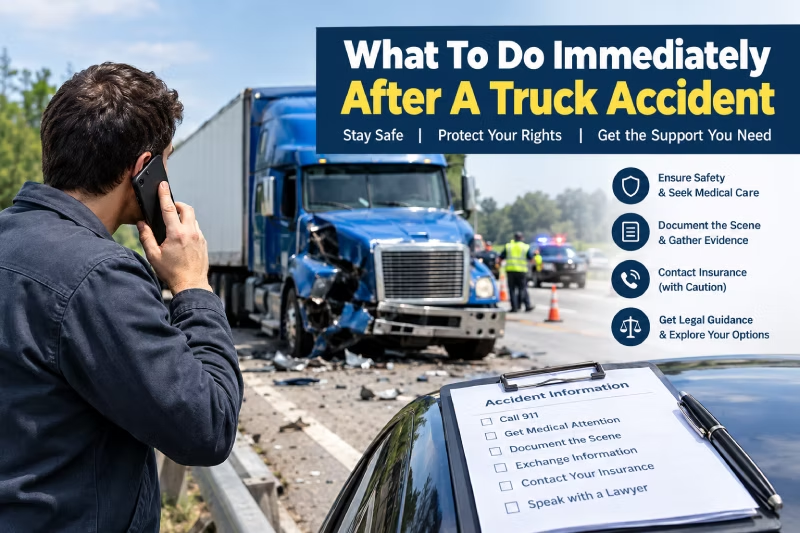
A truck accident can change the course of your life in a matter of seconds. Knowing what you should be doing immediately after a truck accident can help protect your safety, create a clear record of what happened, and preserve evidence that may become important later. The first priority is always safety and medical care, but what you do in the minutes and hours afterward can also affect insurance claims, liability disputes, and a potential personal injury case.
A collision involving a tractor-trailer, semi-truck, 18-wheeler, delivery truck, or other commercial vehicle is not always handled like an ordinary car crash. Commercial vehicles may be connected to a trucking company, motor carrier, maintenance provider, cargo company, leasing company, or other parties. There may also be electronic records, driver logs, vehicle data, company policies, and surveillance footage that can become important to understanding how the collision occurred.
This guide explains the practical steps to take after a truck crash, from the first moments at the scene through medical treatment, evidence preservation, insurance communications, and legal claims. It is written primarily for people involved in truck crashes in the United States, but state laws can differ, so specific legal questions should be reviewed under the law of the state where the collision occurred.
Why the First Minutes After a Truck Accident Matter
The moments immediately following a truck collision can be confusing. You may be frightened, injured, or unsure about what happened. A large truck can also block lanes, create additional traffic hazards, spill cargo, damage roadway barriers, or create a risk of another collision.
The first goal is therefore not to prove fault. The first goal is to stay alive and get people to safety.
Federal truck-crash data shows why these collisions deserve careful attention. FMCSA's Large Truck and Bus Crash Facts program tracks fatal, injury, and property-damage crashes involving large trucks and buses using multiple federal data sources. In 2022, 5,837 large trucks were involved in fatal crashes, while approximately 120,000 large trucks were involved in injury crashes.
More recent FMCSA data also shows the continuing scale of commercial-vehicle crashes. Its current 2024 A&I resource reports 171,274 large truck and bus crashes, 4,872 fatalities, and 87,888 injuries.
These numbers do not mean every truck collision causes a serious injury. They do show why a truck crash should be taken seriously, even when the vehicles initially appear to have suffered limited damage.
First priority: get to a safe location
If you can safely move, get yourself and passengers away from moving traffic.
Depending on the circumstances, this may mean:
- Moving to the shoulder.
- Moving behind a suitable barrier.
- Getting away from damaged vehicles.
- Staying away from leaking fuel or hazardous materials.
- Avoiding traffic lanes when possible.
- Following instructions from police, firefighters, or emergency medical personnel.
Do not put yourself in greater danger simply to take photographs.
If you cannot safely leave the vehicle because of your injuries, remain inside if doing so is safer and wait for emergency responders unless the vehicle presents an immediate danger such as fire or another life-threatening hazard.
Call 911 as soon as possible
Call 911 when there are injuries, significant vehicle damage, roadway hazards, suspected impaired driving, a commercial vehicle crash requiring emergency assistance, or any other serious safety concern.
Give the dispatcher useful information such as:
- Your location.
- The direction of travel.
- Number of vehicles involved.
- Whether anyone is trapped.
- Whether anyone is unconscious or seriously injured.
- Whether fuel, chemicals, or cargo are leaking.
- Whether traffic lanes are blocked.
- Whether there is a fire or other immediate hazard.
If you do not know the exact address, describe the highway, exit, mile marker, nearby business, intersection, or other identifiable location.
Do not assume someone else has called.
For example, imagine a passenger vehicle is struck by a tractor-trailer on an interstate at night. The passenger believes everyone is fine, but another person has a head injury and is becoming confused. Calling 911 immediately can bring medical personnel to the scene before the symptoms become more serious.
Get Medical Attention Even If You Feel Fine
One of the most common mistakes after a serious collision is deciding that medical treatment is unnecessary because there is no obvious injury.
Adrenaline and shock can make it difficult to recognize pain immediately. Symptoms can also become more noticeable after the initial shock wears off.
Possible symptoms after a truck collision can include:
- Neck or back pain.
- Headaches.
- Dizziness.
- Confusion.
- Numbness or tingling.
- Abdominal pain.
- Shoulder or knee pain.
- Reduced range of motion.
- Sleep problems.
- Emotional distress.
A medical professional should determine whether treatment or further testing is appropriate.
Follow the medical provider's instructions
If emergency personnel recommend transportation to a hospital, take that recommendation seriously.
If you are discharged from emergency care, follow the instructions you receive. Attend follow-up appointments and keep records of prescriptions, referrals, physical therapy, diagnostic tests, and other treatment.
This matters for two reasons.
First, your health comes before any insurance or legal claim.
Second, medical records can later help establish what injuries were reported, when they were reported, what treatment was recommended, and how the condition developed.
For example, suppose a person feels only mild neck stiffness immediately after a truck collision. Two days later, the person develops significant pain and sees a doctor. The later medical visit does not automatically mean the injury is unrelated to the crash. The medical history, examination, imaging, timing, and other evidence all matter.
Stay at the Scene Unless Safety or Medical Care Requires Otherwise
Unless you need emergency medical treatment or law enforcement tells you that you can leave, remain at the crash scene.
Leaving can create serious problems, particularly if another person is injured or if authorities need to investigate the collision.
If you must leave for medical treatment, tell police or emergency personnel where you are going if possible.
Truck drivers should also follow applicable company, federal, and state reporting requirements. Commercial drivers may have additional responsibilities depending on the nature and severity of the crash.
Do Not Admit Fault at the Scene
After a collision, people often say things such as:
- "I'm sorry."
- "I didn't see you."
- "I must have been distracted."
- "I was probably going too fast."
- "It was completely my fault."
Even when these statements are made out of shock or courtesy, they can later be taken out of context.
Instead, provide factual information.
You can say:
"I'm willing to give the police the information I know."
You can explain what you personally saw without guessing about facts you do not know.
There is an important difference between describing an event and deciding who is legally responsible for it.
For example, saying "the truck moved into my lane" describes an observation. Saying "the truck driver was legally negligent because he violated the law" is a legal conclusion that may require investigation and evidence.
Exchange Important Information
If you are physically able and it is safe to do so, obtain basic information from the other driver.
For a commercial truck, try to identify:
| Information | What to look for |
|---|---|
| Driver | Name and contact information |
| License | Driver's license information, when appropriate |
| Truck | Unit or vehicle number |
| Trailer | Trailer number |
| Company | Motor carrier or trucking company name |
| Insurance | Insurance company and policy information if available |
| Location | Exact crash location |
| Witnesses | Names and contact information |
| Police | Agency and report information |
Do not put yourself in danger to obtain information.
A tractor-trailer may display several identifying numbers. Photographing the truck from a safe position can help preserve information that may otherwise be difficult to remember.
Take Photographs and Video When It Is Safe
Evidence at a crash scene can disappear quickly.
Vehicles may be moved. Debris may be cleared. Skid marks can fade. Weather conditions can change. Traffic may reopen. Security footage may eventually be overwritten.
If you can safely document the scene, consider photographing:
- Your vehicle.
- The truck.
- The trailer.
- Damage to every involved vehicle.
- License plates.
- Truck identification numbers.
- Road markings.
- Traffic signals and signs.
- Skid marks.
- Debris.
- Vehicle positions.
- Road defects.
- Weather or visibility conditions.
- Nearby businesses and cameras.
- Cargo that has fallen from the truck.
Take wider photographs first and closer photographs afterward.
A close-up photograph may show a damaged bumper, while a wider photograph may show the position of that vehicle relative to the truck, lane markings, intersection, or roadway.
Do not edit the original photographs.
Keep the original files whenever possible. If you make copies for an insurance company, attorney, or another person, preserve the originals separately.
Look for Witnesses
Independent witnesses can become important when drivers provide different versions of the crash.
Ask witnesses for their:
- Full name.
- Telephone number.
- Email address, if they are willing to provide it.
- Basic description of where they were when they saw the collision.
Do not pressure witnesses to take sides.
You can simply ask what they observed and whether they would be willing to provide their contact information to the appropriate authorities or attorneys.
For example, a driver several vehicles behind the collision may have seen a truck change lanes before impact. A pedestrian near an intersection may have seen the traffic signal. A nearby business may have exterior security cameras.
These sources may provide information that the people directly involved in the crash could not see.
Preserve Truck-Specific Evidence
Truck collisions can involve evidence that does not exist in an ordinary passenger-car claim.
One important category is electronic information.
Federal Motor Carrier Safety Administration materials explain that electronic logging devices can automatically record information such as date, time, location information, engine hours, vehicle miles, and driver, vehicle, and motor-carrier identification information.
That information can potentially become relevant when investigating questions about a commercial driver's activities and hours of service.
Depending on the vehicle and circumstances, other potentially relevant evidence can include:
- Electronic control module data.
- Driver logs.
- Hours-of-service records.
- Dispatch records.
- GPS information.
- Dashcam footage.
- Forward-facing camera footage.
- Driver-facing camera footage.
- Cellphone records, when legally obtainable.
- Maintenance records.
- Inspection records.
- Repair records.
- Cargo-loading records.
- Bills of lading.
- Weight records.
- Drug and alcohol testing records where applicable.
- Communications between the driver and carrier.
This does not mean every item will exist or become evidence in every case.
It means that truck crashes can involve a much larger evidence trail than what is visible at the roadside.
Do not try to obtain restricted records yourself
Some commercial-vehicle records may belong to the trucking company or another party. Others may require formal legal procedures to obtain.
If you believe important evidence exists, tell your attorney about it as soon as possible.
An attorney may send an appropriate preservation or spoliation letter to identify records that should be retained while the claim is investigated.
Keep Your Own Accident File
Start a folder for the collision.
Keep copies of:
- Police reports.
- Medical records.
- Medical bills.
- Prescription records.
- Photographs.
- Videos.
- Insurance correspondence.
- Repair estimates.
- Vehicle-storage invoices.
- Towing records.
- Pay records showing lost income.
- Employer communications.
- Witness information.
- Notes about the crash.
Write down what you remember as soon as reasonably possible.
Include details such as:
- Where you were traveling.
- Where the truck was located.
- What happened immediately before impact.
- What you heard.
- What you saw.
- Weather conditions.
- Traffic conditions.
- Whether you noticed turn signals.
- Whether the truck appeared to change lanes.
- What happened immediately after impact.
Do not fill gaps in your memory with guesses.
If you are unsure about something, write that you are unsure.
A contemporaneous note can help preserve your memory, but it should not be treated as a substitute for official evidence or professional investigation.
A Simple Immediate-Action Checklist
If you have just been involved in a serious truck crash, focus on these priorities:
- Get to safety if possible.
- Call 911 when emergency assistance is needed.
- Get medical attention.
- Remain at the scene unless safety or medical care requires otherwise.
- Cooperate with responding officers.
- Exchange basic driver and vehicle information.
- Photograph the scene only when it is safe.
- Identify potential witnesses.
- Do not admit fault or guess about what happened.
- Preserve photographs, records, messages, and other evidence.
- Notify your insurer as required by your policy.
- Consider obtaining legal advice before discussing a serious injury claim in detail with a commercial insurer or trucking company representative.
The order can change when there is an emergency. Safety and medical care always come first.
Truck crashes can involve extensive evidence, and some evidence may be controlled by parties other than the injured person. That is one reason early action can matter.
How the Truck Accident Investigation Usually Begins
Once the immediate emergency is under control, the focus usually shifts from protecting people to preserving facts.
A truck accident investigation may involve police officers, insurance companies, trucking-company representatives, investigators, medical providers, and attorneys. In serious cases, the investigation can also involve accident reconstruction professionals, engineers, trucking-safety specialists, or other experts.
The purpose is to determine what happened and identify the evidence that supports or disputes each version of events.
A proper investigation may examine:
- Driver actions before the crash.
- Vehicle speed and movement.
- Lane changes.
- Following distance.
- Traffic signals and signs.
- Road conditions.
- Weather and visibility.
- Driver fatigue.
- Hours-of-service compliance.
- Vehicle maintenance.
- Tire and brake condition.
- Cargo loading and securement.
- Driver qualifications.
- Company policies and supervision.
- Electronic vehicle information.
- Witness statements.
- Video evidence.
The important point is that the visible damage is only one part of the investigation.
For example, a truck may have rear-end damage after hitting a passenger vehicle. The photograph of the damaged truck establishes that contact occurred, but it does not necessarily explain why the collision occurred. Investigators may need to examine speed, braking, traffic conditions, driver attention, roadway conditions, and other evidence.
Understand the Role of the Police Crash Report
Police officers who respond to a serious collision may document the scene, interview drivers and witnesses, identify apparent traffic violations, photograph vehicles, record road conditions, and prepare a crash report.
A police report can be important, but it is not necessarily the final word on civil liability.
An officer may arrive after the vehicles have moved, after witnesses have left, or after important physical evidence has changed. The officer may also have limited information at the time the report is prepared.
For that reason, a later civil investigation may uncover additional evidence.
If you receive a copy of the report, review it carefully. Check whether basic information such as your name, vehicle, location, direction of travel, and insurance information is accurate.
If you believe a material fact is incorrect, discuss it with an attorney or the appropriate law-enforcement agency rather than altering the document yourself.
Do not argue with officers at the scene
If an officer asks what happened, answer truthfully.
If you do not remember something, it is acceptable to say that you do not remember.
Do not guess simply because you feel pressure to provide an answer.
A statement such as "I don't know how fast the truck was traveling" is more reliable than inventing a speed based on what you think happened.
Preserve Electronic Logging Device and Hours-of-Service Evidence
Commercial truck crashes can involve electronic evidence that is impossible for an ordinary passenger-vehicle driver to see.
The Federal Motor Carrier Safety Administration explains that an electronic logging device, or ELD, automatically records driving time and other information connected with hours-of-service records. Depending on the system, information can include vehicle movement, engine hours, miles, location, date, time, and driver identification.
FMCSA also explains that ELD systems maintain records for the current 24-hour period and the previous seven consecutive days, while applicable requirements can involve broader record-retention periods and data available for inspection.
This evidence can become relevant when there are questions about:
- How long the driver had been working.
- How long the driver had been driving.
- When the truck stopped.
- Where the truck was located.
- Whether the vehicle was moving.
- Whether the driver's recorded duty status matches other evidence.
- Whether fatigue may have been a factor.
This does not mean that an ELD automatically proves negligence. Electronic records must be interpreted in context and compared with other evidence.
Other electronic evidence may matter
An investigation may also consider:
- Engine-control-module information.
- GPS records.
- Fleet-management data.
- Dashcam footage.
- Driver-facing cameras.
- Forward-facing cameras.
- Dispatch messages.
- Electronic communications.
- Toll records.
- Weigh-station information.
- Navigation data.
- Digital delivery records.
The exact evidence available depends on the truck, carrier, technology, route, and circumstances of the crash.
Request Preservation of Important Evidence
One of the most important legal steps after a serious commercial-truck collision can be identifying evidence before it disappears.
A lawyer may send a preservation-of-evidence letter, sometimes called a spoliation letter, to parties that may possess relevant information.
The letter can identify categories of evidence that should be preserved while the claim is investigated.
Potential categories can include:
- ELD records.
- Driver logs.
- Vehicle data.
- Dashcam recordings.
- Security footage.
- Driver communications.
- Maintenance records.
- Inspection records.
- Repair records.
- Cargo records.
- Dispatch records.
- Driver qualification records.
- Accident reports.
- Photographs.
- Drug and alcohol testing records where applicable.
FMCSA guidance specifically states that motor carriers must retain information about particular accidents that they or their drivers generate to satisfy accident-reporting obligations to government entities or the carrier's insurer.
That does not mean every possible piece of evidence is automatically preserved forever. Different records can have different retention rules, and private litigation can create additional preservation duties.
That is why early evidence identification matters.
Be Careful When the Trucking Company Calls
After a serious collision, you may receive a telephone call from an insurance adjuster, trucking company representative, claims administrator, investigator, or another person connected with the commercial carrier.
Some of these contacts are routine.
The problem is that you may not know exactly who is calling, who they represent, what information they already have, or how your statement may later be used.
Before discussing a serious injury claim in detail, determine:
- Who is calling?
- What company do they represent?
- What is their role?
- Which insurer are they working for?
- What claim number is involved?
- What information are they requesting?
- Are they asking for a recorded statement?
- Are they requesting medical records or authorizations?
You should always be truthful.
But being truthful does not require guessing, exaggerating, minimizing symptoms, or giving a detailed recorded statement before you understand what is being requested.
For example, saying "I need to review this request before providing additional information" is different from refusing to cooperate with a legitimate claim investigation.
Notify Your Own Insurance Company
Your own automobile insurance policy may contain requirements for reporting a collision.
Follow the notice requirements that apply to your policy.
When reporting the crash, provide accurate information about:
- Date and location.
- Vehicles involved.
- Police response.
- Known injuries.
- Contact information.
- Claim information from the other party, if available.
Do not speculate about legal fault.
You can report what happened without deciding the entire liability question.
If you have uninsured or underinsured motorist coverage, that coverage may become relevant depending on the circumstances and the applicable state law and policy terms.
Trucking Insurance Can Be More Complicated Than Ordinary Auto Insurance
A commercial truck may be associated with several layers of business and insurance relationships.
The truck driver may work for:
- A motor carrier.
- An owner-operator.
- A leased carrier.
- A private fleet.
- A logistics company.
- Another transportation business.
There can also be questions involving:
- Vehicle owners.
- Trailer owners.
- Maintenance contractors.
- Cargo owners.
- Shippers.
- Brokers.
- Manufacturers.
- Other drivers.
The existence of multiple companies does not automatically mean every company is legally responsible for a collision.
Responsibility depends on the facts, contracts, applicable law, and evidence.
FMCSA requires certain interstate motor carriers to maintain financial responsibility, and FMCSA maintains federal insurance filings such as BMC and MCS forms. The MCS-90 is an endorsement attached to certain motor-carrier liability policies subject to federal financial-responsibility requirements.
These federal requirements should not be confused with the amount a particular injured person will ultimately recover. Insurance limits, coverage, liability, damages, and settlement value are separate questions.
Do Not Assume the Truck Company's Insurer Is Your Advocate
An insurance adjuster may be professional, polite, and helpful.
That does not change the fact that an adjuster generally works for an insurance company whose interests may differ from yours.
This becomes especially important when injuries are serious.
An adjuster may ask about:
- How the crash happened.
- Whether you were injured.
- Your previous medical history.
- Your employment.
- Your current symptoms.
- Treatment.
- Lost income.
- Prior accidents.
- Prior claims.
Answer questions truthfully, but do not provide false information or speculate.
If you have hired an attorney, provide the attorney's contact information and follow the advice you receive about future communications.
Be Careful With a Quick Settlement Offer
An insurance company may make an early settlement offer before the full extent of an injury is known.
An early offer can appear attractive, especially when medical bills, vehicle expenses, lost wages, or household expenses are piling up.
But accepting a settlement can have significant consequences.
A settlement agreement may require you to release claims connected with the collision. Depending on the language and applicable law, that can prevent you from later seeking additional compensation for injuries that become apparent afterward.
Before accepting a settlement, understand:
- What claims are being released.
- Whether medical expenses are included.
- Whether future medical care is included.
- Whether lost wages are included.
- Whether property damage is resolved separately.
- Whether liens or medical bills remain.
- Whether the agreement is final.
- Whether the settlement affects other potential claims.
Never assume an offer is adequate simply because it arrives quickly.
A lawyer can review the facts and explain the legal issues that may affect a settlement decision.
Document Your Injuries and Daily Problems
A medical record is important, but your own day-to-day records can also help explain how an injury affects your life.
Consider keeping a simple recovery journal.
Record:
- Pain levels.
- Sleep problems.
- Missed work.
- Medical appointments.
- Physical limitations.
- Difficulty driving.
- Difficulty lifting.
- Household tasks you cannot perform.
- Medication side effects.
- Changes in normal activities.
Keep the entries factual.
For example:
"I could not lift my child from the floor today because of back pain."
is more useful than:
"My injuries are terrible."
Specific details make it easier to understand the practical effect of an injury.
Keep Track of Financial Losses
A truck accident can create expenses that are easy to overlook.
Save documentation for:
- Hospital bills.
- Doctor bills.
- Pharmacy expenses.
- Physical therapy.
- Medical equipment.
- Travel to medical appointments.
- Towing.
- Vehicle storage.
- Rental vehicles.
- Vehicle repairs.
- Lost wages.
- Reduced work hours.
- Other reasonable accident-related expenses.
If you miss work, keep records showing the dates and, where available, the amount of income lost.
If you are self-employed, preserve business records that can help establish the financial impact of the injury.
Do not inflate losses.
The goal is to create an accurate record, not to manufacture damages.
What If the Truck Driver Says You Caused the Crash?
Do not panic.
Two drivers can give different accounts of the same collision.
The legal process is not necessarily decided by whoever speaks first or sounds most confident.
Evidence may include:
- Photographs.
- Vehicle damage.
- Skid marks.
- Black-box or vehicle data.
- ELD records.
- Dashcam footage.
- Surveillance video.
- Witness statements.
- Police observations.
- Roadway evidence.
- Medical records.
- Driver statements.
- Truck inspection records.
For example, imagine a truck driver says the passenger vehicle suddenly stopped. A nearby traffic camera may show that the passenger vehicle had stopped because of congestion and that the truck approached from behind without enough stopping distance.
The video could materially change the understanding of the collision.
This is why a complete evidence review is often more useful than relying on a single statement.
When Should You Speak With a Truck Accident Attorney?
Not every minor traffic collision requires an attorney.
A legal consultation becomes particularly important when a truck crash involves:
- Serious injury.
- Permanent impairment.
- A fatality.
- Multiple vehicles.
- Significant property damage.
- A disputed version of events.
- A commercial insurance policy.
- A trucking company or fleet.
- Potential driver fatigue.
- Possible hours-of-service issues.
- Suspected mechanical problems.
- Hazardous cargo.
- Significant lost income.
- A substantial settlement offer.
- A claim involving multiple potentially responsible parties.
An attorney can review the circumstances and explain what legal claims may exist under the applicable state law.
The earlier an attorney becomes involved in a serious case, the earlier the evidence-preservation process can begin.
How a Truck Accident Attorney May Investigate the Claim
A truck accident attorney may begin by collecting the client's account and existing documents.
The investigation can then expand into several areas.
Reviewing the crash evidence
The attorney may examine:
- Police reports.
- Photographs.
- Video.
- Witness information.
- Vehicle damage.
- Medical records.
- Insurance documents.
- Commercial-driver information.
- Trucking-company information.
Investigating the carrier
Depending on the facts, an investigation may look at the trucking company's identity, operating authority, safety history, vehicle ownership, insurance information, and other available records.
FMCSA provides federal information concerning motor carriers and their operating authority and insurance filings.
Investigating the driver
Potential issues can include:
- Driver qualification.
- Training.
- Licensing.
- Hours of service.
- Prior safety concerns where legally relevant.
- Employer supervision.
- Drug and alcohol testing where applicable.
- Driver communications.
Again, the existence of a particular record does not automatically establish liability. The evidence must be connected to the facts of the crash.
How Liability May Be Evaluated
A truck accident claim can involve more than one legal theory.
Depending on state law and the facts, an investigation may consider whether the crash resulted from:
- Driver negligence.
- Employer negligence.
- Improper hiring or supervision.
- Unsafe maintenance.
- Defective equipment.
- Improper cargo loading.
- Roadway conditions.
- Another driver's conduct.
- A combination of factors.
The legal standard varies by jurisdiction.
In some cases, several parties may share responsibility. In others, evidence may show that one party was primarily responsible.
That is why it is risky to decide the entire legal case from photographs alone.
Understanding Damages in a Truck Accident Claim
If liability can be established, the next major issue is damages.
Potential categories can include:
- Medical expenses.
- Future medical care.
- Lost wages.
- Loss of earning capacity.
- Property damage.
- Rehabilitation.
- Out-of-pocket expenses.
- Pain and suffering.
- Emotional distress where recognized by applicable law.
- Other legally recoverable losses.
The exact categories and methods of proving damages vary by state.
For example, a person who misses two weeks of work because of a minor injury may have a very different damages claim from someone who suffers a permanent spinal injury and can no longer perform the same occupation.
A serious claim therefore requires more than adding up medical bills.
Why Settlement Value Cannot Be Determined From One Number
People often search for an average truck accident settlement.
There is no reliable universal settlement amount.
Two collisions can look similar from photographs but produce completely different legal outcomes because of differences in:
- Liability.
- Injury severity.
- Medical treatment.
- Long-term prognosis.
- Lost income.
- Insurance coverage.
- Available evidence.
- Comparative-fault rules.
- Venue.
- Applicable state law.
- Litigation risk.
A settlement should therefore be evaluated based on the specific facts rather than an online average.
Use Search-Friendly Answers Without Sacrificing Legal Accuracy
A well-written legal article should answer common questions directly.
This is where snippet-friendly formatting, paragraph snippet optimization, and question header optimization can improve usability. A direct answer followed by supporting details is usually easier for readers to scan than a long paragraph that hides the main point.
For example:
What should you do first after a truck accident?
Move to a safe location if possible, call 911 when emergency assistance is needed, and obtain medical attention. Once immediate safety concerns are handled, preserve evidence, exchange information, identify witnesses, and avoid guessing or admitting fault about the cause of the collision.
That is an example of concise answer writing without removing the explanation a reader needs.
Similarly, list snippet optimization can make a checklist easier to understand:
- Call 911.
- Get medical care.
- Remain at the scene.
- Photograph the crash when safe.
- Gather identifying information.
- Preserve evidence.
- Notify your insurer.
- Consider legal advice for serious injuries.
The goal is not to chase a particular search position. Terms such as position zero ranking, snippet bait content, snippet win rate, and featured snippet types are useful concepts when planning search-friendly content, but no formatting technique guarantees a featured snippet or AI-generated search answer.
The stronger approach is to provide a direct answer first and then give enough context to make that answer genuinely useful.
A Practical Evidence Table for Truck Crash Victims
| Evidence | Why it may matter | What you can do |
|---|---|---|
| Police report | Documents the initial investigation | Request and review it |
| Photos | Shows vehicle and scene conditions | Preserve originals |
| Witness information | May support an independent account | Save names and contact details |
| Dashcam footage | May show events before impact | Identify potential sources quickly |
| ELD records | May show driving and duty information | Tell your attorney if relevant |
| Vehicle data | May provide information about vehicle operation | Preserve through proper legal channels |
| Medical records | Document injuries and treatment | Follow treatment and keep records |
| Wage records | May establish income loss | Save pay stubs and employer records |
| Maintenance records | May be relevant to mechanical issues | Request through appropriate legal process |
| Cargo records | May matter where loading or securement is disputed | Identify the shipper/carrier |
The table is designed for table snippet formatting as well as practical use. It should never replace a case-specific investigation.
Avoid These Common Mistakes After a Truck Accident
Some mistakes are made because people are overwhelmed. Others happen because someone wants to resolve the situation quickly.
Try to avoid:
Leaving the scene unnecessarily.
If you can remain safely, do so unless emergency medical care or official instructions require otherwise.
Posting about the crash online.
Social-media posts, photographs, comments, and messages can become part of a dispute. Avoid discussing fault or the details of your claim publicly.
Deleting messages or photographs.
Preserve potentially relevant information rather than cleaning up your phone.
Guessing about your injuries.
You are not expected to diagnose yourself. Let medical professionals evaluate you.
Guessing about speed or distance.
If you do not know, say so.
Accepting a settlement without understanding the release.
A settlement may affect future claims.
Waiting too long to investigate serious evidence.
Video, electronic information, witness availability, and physical evidence can become harder to obtain over time.
What Truck Drivers Should Do After a Crash
The steps above primarily address people injured in a truck collision, but truck drivers have their own responsibilities.
A driver should first protect human life and request emergency assistance.
After that, the driver should follow applicable federal, state, and company procedures.
A driver should not:
- Alter records.
- Delete relevant communications.
- Disable or manipulate evidence.
- Create a false account.
- Guess about facts.
- Admit legal fault without understanding the circumstances.
The driver should accurately document what happened and comply with legitimate reporting requirements.
ELD requirements are designed to record hours-of-service information electronically for drivers who are subject to the applicable rules, although exemptions exist for certain operations.
A driver should therefore preserve required records rather than attempting to recreate or modify the history of the trip after the crash.
What Families Should Do After a Serious Truck Crash
When someone is hospitalized after a major truck collision, family members often become responsible for practical tasks while the injured person focuses on treatment.
A family member can help by maintaining a central file containing:
- Hospital information.
- Insurance contacts.
- Police report information.
- Photographs.
- Witness details.
- Employer information.
- Medical bills.
- Treatment appointments.
- Receipts.
- Correspondence.
- Attorney contact information.
Keep the records organized by date.
For a long recovery, this simple organization can become extremely valuable.
For example, instead of having dozens of photographs, bills, and emails scattered across different phones and accounts, create folders such as Crash, Medical, Insurance, Employment, and Legal.
That makes it easier to provide accurate information to an attorney, insurer, or medical provider when needed.
The Next Stage: From Accident Scene to Legal Claim
The transition from a truck accident scene to a legal claim generally involves several stages.
First comes immediate safety and medical care.
Then comes evidence preservation and investigation.
After that, depending on the facts, the injured person may pursue an insurance claim, negotiate a settlement, file a lawsuit, or take another legal route available under state law.
The process is not always linear.
New evidence can change the investigation. Medical treatment can reveal the seriousness of an injury. An insurer may dispute liability. A witness may provide new information. An attorney may discover another potentially responsible party.
That is why a serious truck accident should be treated as an evolving investigation rather than a problem that can always be resolved in one phone call.
The most important principle is simple:
Protect your health first, preserve the evidence second, and make major legal or settlement decisions only after you understand the available facts.
What Happens After You Hire a Truck Accident Attorney?
If you decide to work with an attorney after a serious truck crash, the first stage is usually information gathering.
The attorney will want to understand what happened, what injuries resulted, what evidence already exists, what insurance coverage may apply, and whether additional evidence needs to be preserved.
A typical investigation can involve:
- Reviewing the police report.
- Reviewing photographs and videos.
- Interviewing witnesses.
- Reviewing medical records.
- Examining vehicle damage.
- Identifying the truck's owner and motor carrier.
- Investigating insurance coverage.
- Examining available trucking records.
- Identifying potential defendants.
- Reviewing applicable state and federal regulations.
- Calculating economic losses.
- Evaluating future medical needs.
- Determining whether expert testimony may be necessary.
The investigation may take time because a serious truck case often involves more evidence than a simple property-damage collision.
FMCSA's national crash resources illustrate the scale of the commercial-vehicle system being investigated. Current FMCSA A&I data reports 164,199 large truck and bus crashes, 4,521 fatalities, and 85,870 injuries for calendar year 2025, while also warning that 2025 crash data remains provisional because reporting is still ongoing.
That distinction matters. A current statistic should always be identified by its reporting year and data status rather than treated as a permanent number.
How a Truck Accident Settlement Usually Works
A settlement is an agreement in which the parties resolve some or all of the legal claims without continuing to trial.
In a serious truck accident case, the process may involve several stages.
Investigation and medical treatment
The attorney gathers evidence while the injured person continues medical care.
It can be difficult to evaluate the full effect of a serious injury before doctors understand the prognosis.
For example, a person with a fractured leg may initially expect to return to work within several weeks. Later, complications or continuing limitations may affect the person's ability to perform the same job.
That is one reason settlement discussions should be based on reliable medical information rather than simply the first hospital bill.
Demand and negotiation
Once the evidence and damages have been developed sufficiently, the attorney may present a demand to the appropriate insurer or opposing party.
The demand may explain:
- How the collision occurred.
- Why the other party is legally responsible.
- The injuries involved.
- Medical treatment.
- Lost income.
- Property damage.
- Other economic losses.
- Non-economic damages where permitted.
- Supporting evidence.
The insurer may accept the demand, reject it, or make a counteroffer.
Negotiations can continue through multiple rounds.
There is no rule that says every truck accident claim must settle quickly.
What Is a Settlement Release?
Before accepting a settlement, read the release carefully.
A release is a legal document that can give up specified claims in exchange for payment.
The language matters.
Questions can include:
- Which parties are being released?
- Which claims are being released?
- Does the release cover unknown injuries?
- Does it address medical liens?
- Does it resolve property damage?
- Does it resolve future medical claims?
- Does it affect claims against other parties?
The exact effect depends on the document and applicable state law.
A settlement should therefore be treated as a legal decision, not simply a check arriving from an insurance company.
The National Association of Insurance Commissioners advises consumers not to feel rushed or forced into accepting an insurance settlement they are uncomfortable with and notes that consumers can request explanations of claim decisions and seek assistance from their state insurance department when appropriate.
What If the Insurance Company Will Not Pay Enough?
A disputed claim does not automatically mean a lawsuit is the only option.
Depending on the circumstances, the parties may continue negotiating, use another dispute-resolution process, or pursue litigation.
The appropriate strategy depends on:
- The evidence.
- The injuries.
- The amount in dispute.
- Insurance coverage.
- Applicable state law.
- The strength of liability evidence.
- The potential cost and duration of litigation.
Do not assume that filing a lawsuit guarantees a particular result.
Litigation creates additional obligations, costs, deadlines, and risks.
What Happens When a Truck Accident Lawsuit Is Filed?
If settlement negotiations do not resolve a serious claim, a lawsuit may be filed in the appropriate court.
The process varies by jurisdiction, but a civil case commonly involves stages such as:
- Complaint
- Answer
- Discovery
- Depositions
- Expert investigation
- Motions
- Settlement negotiations
- Trial, if necessary
Many cases resolve before trial.
That does not mean a lawsuit was unnecessary. Sometimes filing a case is part of the process required to preserve legal rights or move negotiations forward.
Discovery
Discovery allows parties to obtain relevant information from one another.
Depending on the case, discovery may involve:
- Interrogatories.
- Requests for production.
- Requests for admission.
- Subpoenas.
- Depositions.
- Medical records.
- Employment records.
- Trucking records.
- Maintenance documents.
- Electronic evidence.
- Photographs and videos.
A serious truck case may involve extensive discovery because commercial carriers can maintain large amounts of operational information.
Expert Witnesses in Truck Accident Cases
Some truck accident cases require expert analysis.
Potential experts can include:
- Accident reconstruction specialists.
- Trucking-safety experts.
- Mechanical engineers.
- Human-factors experts.
- Medical specialists.
- Economists.
- Vocational rehabilitation professionals.
An accident reconstruction expert might analyze vehicle damage, photographs, roadway evidence, measurements, video, and other information to evaluate how a collision occurred.
A medical expert may explain the nature of an injury, treatment, prognosis, and whether future care may be necessary.
An economist or vocational expert may become relevant when an injury affects long-term earning capacity.
Expert testimony is not automatically necessary in every case.
Its usefulness depends on the disputed issues and applicable rules of evidence.
Federal Trucking Rules May Matter
Truck accident cases can involve federal regulations administered by agencies such as FMCSA.
Depending on the circumstances, investigators may consider rules involving:
- Driver qualifications.
- Hours of service.
- Vehicle inspection.
- Maintenance.
- Cargo securement.
- Drug and alcohol testing.
- Electronic logging devices.
- Commercial driver's licensing.
- Safety management.
The existence of a regulatory violation does not automatically answer every question in a personal injury case.
A lawyer must determine whether the regulation applies, whether it was violated, whether the violation is supported by evidence, and what legal effect the violation has under the law of the relevant state.
That distinction is important because regulatory compliance and civil liability are related but not identical concepts.
State Laws Can Change the Outcome
Truck accident law is not completely uniform across the United States.
The state where the crash occurred can affect important issues such as:
- Filing deadlines.
- Comparative negligence.
- Contributory negligence.
- Damages.
- Wrongful-death claims.
- Insurance requirements.
- Evidence rules.
- Medical liens.
- Settlement procedures.
- Government claims.
- Procedural requirements.
Statutes of limitation
Every injured person should pay attention to the applicable deadline for bringing a legal claim.
The deadline is often called a statute of limitations.
The exact period varies by state and can depend on:
- The type of claim.
- Who is being sued.
- Whether the defendant is a government entity.
- Whether the claim involves wrongful death.
- The age or legal status of the injured person.
- When the injury was discovered.
- Other statutory exceptions.
There can also be separate notice requirements that arise before a lawsuit against a government entity.
Do not rely on a generic online deadline.
A deadline that applies in one state may be wrong in another.
An attorney licensed in the relevant jurisdiction can determine which deadlines apply to the specific claim.
Comparative Fault Can Matter
A truck accident does not necessarily become an all-or-nothing case simply because both sides made mistakes.
Many states use some form of comparative-fault system, but the rules differ.
Under a comparative-fault system, a person's recovery may be reduced based on the percentage of responsibility assigned to that person, subject to the state's specific rules.
Other jurisdictions use different approaches.
For example, suppose a jury finds that a truck driver was responsible for 80% of a collision and the passenger driver was responsible for 20%. The financial effect of those percentages depends on the law governing the case.
This is only a simplified example.
The actual rules can differ significantly between states, and some states have thresholds or other restrictions that can affect recovery.
Wrongful Death After a Truck Accident
Some truck collisions result in death.
When that happens, the legal issues become especially serious and emotionally difficult.
A wrongful-death claim may involve losses such as:
- Medical expenses before death.
- Funeral expenses.
- Lost financial support.
- Loss of services.
- Loss of companionship.
- Other damages recognized by the applicable state law.
The person legally entitled to bring the claim depends on state law.
For example, a spouse, child, personal representative, or another specified person may have standing under a particular state's wrongful-death statute.
Families should obtain state-specific legal advice quickly because wrongful-death claims can have different procedures and deadlines from ordinary personal injury claims.
What If the Truck Was Carrying Hazardous Materials?
Some commercial trucks transport hazardous materials.
If hazardous material is spilled, the crash may create additional risks involving:
- Fire.
- Explosion.
- Toxic exposure.
- Environmental contamination.
- Road closures.
- Emergency evacuation.
Do not approach spilled cargo simply to photograph it.
Stay away from the affected area and follow instructions from emergency personnel.
FMCSA's crash data shows that hazardous-material cargo was present on a minority of large trucks involved in reported fatal and injury crashes in 2022, and releases occurred in a portion of crashes involving placarded hazardous-material trucks.
The practical lesson is straightforward: treat unknown spills as potentially dangerous until emergency responders determine otherwise.
How to Use Photos, Videos, and Social Media Wisely
Your phone can become an important evidence tool after a crash.
But use it carefully.
Keep original photographs and videos.
Avoid:
- Cropping out important context.
- Adding filters.
- Editing timestamps.
- Deleting unfavorable photographs.
- Posting accusations.
- Posting private medical information.
- Discussing settlement negotiations publicly.
Social media can also create confusion about a person's physical condition.
For example, posting a photograph of yourself attending a family event does not necessarily mean you have recovered from an injury. But a short social-media post can be misunderstood when separated from the full medical history.
The safest approach during an active claim is to avoid publicly discussing the details of the accident, injuries, or legal dispute.
A Complete Truck Accident Action Checklist
Use this checklist as a practical reference after a serious collision.
At the crash scene
- Get to safety.
- Call 911 when necessary.
- Help others only when it is safe to do so.
- Do not move an injured person unless required by an immediate danger.
- Remain at the scene when possible.
- Cooperate with emergency responders.
- Avoid admitting fault.
- Exchange basic information.
- Identify witnesses.
- Photograph the scene when safe.
Within the first day
- Obtain medical evaluation.
- Follow discharge instructions.
- Notify your insurer as required.
- Save the police report information.
- Save photographs and videos.
- Write down what you remember.
- Record the names of witnesses.
- Save towing and repair information.
- Avoid social-media discussions about fault.
During the following days and weeks
- Attend medical appointments.
- Follow treatment recommendations.
- Track expenses.
- Track missed work.
- Preserve employment records.
- Save insurer communications.
- Be careful with recorded statements.
- Identify potential video or electronic evidence.
- Consider a legal consultation if the injuries or damages are significant.
If you retain an attorney
Provide:
- Police reports.
- Medical records.
- Bills.
- Insurance information.
- Photos.
- Videos.
- Witness contacts.
- Employment information.
- Pay records.
- Vehicle information.
- Communications with insurers.
- Any information identifying the truck, carrier, or trailer.
Do not delete relevant material simply because you believe it is unimportant.
Let the legal team determine what may matter.
A Final Practical Guide for Truck Accident Victims
The simplest way to remember the process is:
Safety → Medical Care → Documentation → Evidence → Insurance → Legal Review
Safety comes first.
Medical treatment comes next.
Then preserve information while it is still available.
Do not assume that the first explanation of the crash is necessarily the complete explanation. Commercial truck collisions can involve drivers, carriers, vehicles, maintenance, cargo, roadway conditions, electronic records, witnesses, and other evidence.
The National Association of Insurance Commissioners similarly advises people involved in collisions to prioritize safety, collect information, document the scene, notify their insurer promptly, keep records of communications, and seek additional help when a claim dispute cannot be resolved.
Final Takeaways
A serious truck collision can leave you dealing with medical treatment, vehicle damage, lost income, insurance questions, and uncertainty about what happens next.
You do not need to solve every legal issue at the crash scene.
Your immediate job is to protect yourself and others, obtain appropriate medical care, report the collision, preserve evidence, and avoid making unsupported statements about fault.
After that, the case can be investigated more carefully.
For serious injuries, a truck accident attorney can help identify potentially responsible parties, preserve evidence, communicate with insurers, evaluate damages, and determine whether negotiation or litigation is appropriate.
The most important evidence may not be sitting on the pavement when you leave the scene. It may exist in a camera recording, electronic vehicle system, driver log, maintenance file, dispatch record, medical chart, employment record, or witness account.
That is why acting carefully after a truck accident matters.
Preserve the facts. Protect your health. Know your rights.
And before signing a settlement, releasing claims, or making a major legal decision, make sure you understand what you may be giving up under the law that applies to your case.
Frequently Asked Questions (FAQs)
What should I do immediately after a truck accident?
Get to a safe location if possible, call 911 when emergency assistance is needed, obtain medical care, remain at the scene when safe, exchange information, document the crash, and avoid admitting fault or guessing about what happened.
Should I go to the hospital after a truck accident?
If you have serious symptoms or emergency personnel recommend medical treatment, seek emergency care. Even when symptoms initially seem minor, medical evaluation can help identify injuries and establish an appropriate treatment plan.
Should I talk to the trucking company's insurance company?
You should be truthful when communicating about the collision, but you should understand who is requesting information and why. If the collision caused significant injuries or a substantial claim is involved, consider obtaining legal advice before providing a detailed recorded statement or signing documents.
What if I do not feel injured immediately?
Monitor your condition and follow appropriate medical advice. Some symptoms may become apparent after the initial shock of a collision wears off. Do not ignore new or worsening symptoms.
What if the truck driver says I caused the crash?
Do not argue at the scene. Give the police your factual account and preserve available evidence. Liability may depend on photographs, witnesses, video, vehicle data, roadway evidence, and other information.
What if the trucking company contacts me directly?
Record the caller's identity, company, claim number, and contact information. Do not lie or destroy evidence. If you have significant injuries, consider speaking with an attorney before providing extensive statements or signing releases.
How long do I have to file a truck accident claim?
There is no single deadline for every truck accident in the United States. The applicable statute of limitations and any special notice requirements depend on the state, claim type, defendant, and circumstances. Get state-specific legal advice rather than relying on a general internet deadline.
How much is a truck accident claim worth?
There is no reliable universal amount. Value can depend on liability, injury severity, medical treatment, future care, lost income, insurance coverage, evidence, applicable law, and other case-specific factors.
Do I need an attorney for a truck accident?
A minor crash with no injury may be handled without an attorney. Legal advice becomes more important when there are serious injuries, disputed liability, substantial financial losses, multiple parties, commercial insurance, permanent impairment, or a potential wrongful-death claim.
What evidence should I preserve?
Preserve photographs, videos, medical records, police documents, witness information, insurance communications, bills, employment records, repair documents, and anything identifying the truck, driver, trailer, or trucking company.
Ready to take the next step?
Use our free tools to estimate your case value, organize evidence, and connect with a vetted attorney.


